
Legendary Reunion: Full Cast and Crew Credits for the ‘I Am Legend’ Sequel Shattering May 2026 Box Office Streaks
The cinematic landscape of 2026 has been officially dominated by a single title: I Am Legend: Resurrection. As the film enters its second weekend, the industry is reeling from a box office performance that has shattered May records, proving that the appetite for high-stakes, theatrical sci-fi remains insatiable. Beyond the spectacle of a post-apocalyptic New York, the film’s success is a testament to the powerhouse collaboration between returning veterans and new Hollywood royalty.
Table of Contents
- The Evolution of the Legend
- The Headline Duo: Smith and Jordan
- The Supporting Ensemble
- Visionary Direction and Screenplay
- Technical Mastery: Cinematography and Sound
- The Industrial Impact
{{IMAGE_1}}
The Evolution of the Legend
For nearly two decades, the legacy of Robert Neville remained suspended in the amber of the 2007 original film. However, the 2026 sequel makes a bold narrative choice by canonizing the ‘Alternate Ending’ of the first film, where Neville survives his encounter with the Darkseekers. This pivot allowed Warner Bros. to craft a narrative that isn’t just a sequel, but a sophisticated expansion of Richard Matheson’s original themes of isolation and humanity. The production, which spent nearly eighteen months in principal photography and post-production, represents one of the most ambitious theatrical undertakings of the decade.
The Headline Duo: Smith and Jordan
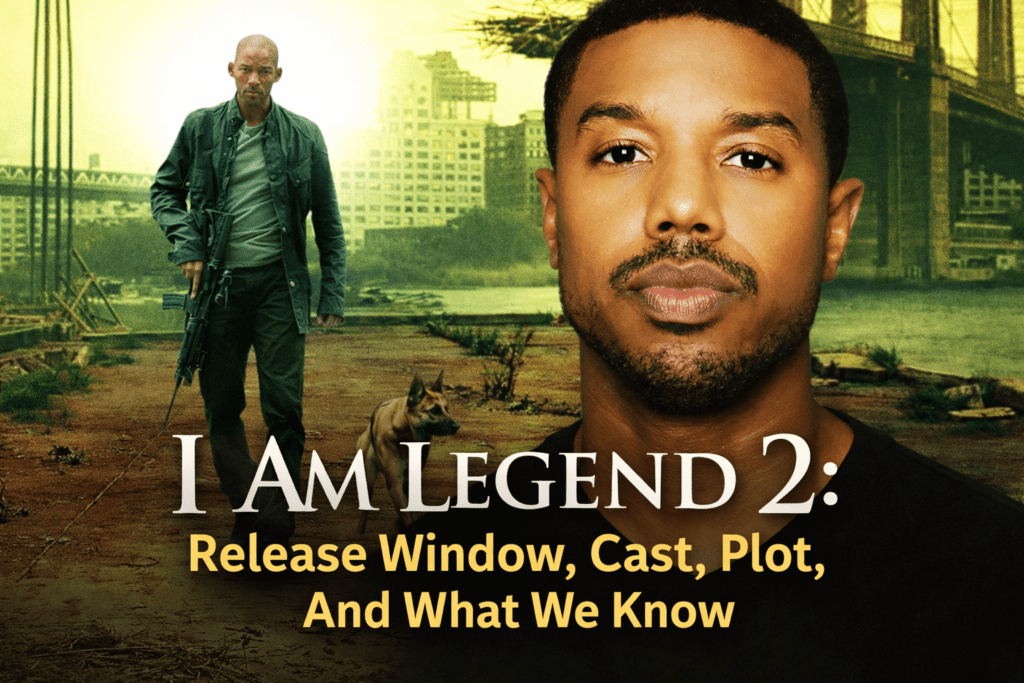
The gravitational pull of I Am Legend: Resurrection rests squarely on the shoulders of Will Smith and Michael B. Jordan. Smith returns to the role of Robert Neville with a weary, weathered gravitas that reflects the passage of time both in-universe and in reality. His performance is a masterclass in silent storytelling, utilizing the vast, empty spaces of the reclaimed urban wilderness to convey a deep sense of survivalist fatigue.
Opposite Smith, Michael B. Jordan joins the franchise as Valerius, a leader of a survivor colony from the remains of the midwest. Jordan’s presence brings a kinetic energy to the film, contrasting Neville’s methodical stillness with a more proactive, hopeful approach to reclaiming the world. The chemistry between the two leads—often described as a ‘passing of the torch’ that burns twice as bright—is the primary engine driving the film’s massive repeat viewership.
{{IMAGE_2}}
The Supporting Ensemble
While the marketing has focused on the central duo, the supporting cast provides the emotional texture necessary for such a bleak world. Alice Braga returns in a pivotal cameo as Anna, bridging the gap between the two eras of the story. Newcomers include rising star Amandla Stenberg as Maya, a scavenger with a mysterious connection to the Darkseeker evolution, and veteran character actor Willem Dafoe, who portrays a reclusive scientist living in the ruins of the New York Public Library.
The casting of the ‘Alpha’ Darkseekers also deserves note. Utilizing advanced performance capture rather than pure CGI, the production brought in world-class movement artists to give the antagonists a terrifying, animalistic realism that was missing from the original’s digital-heavy approach. This shift toward grounded, physical performances has been cited by critics as a major reason for the film’s visceral tension.
Visionary Direction and Screenplay
Francis Lawrence returns to the director’s chair, bringing a visual maturity that has evolved significantly since his work on the first film and The Hunger Games franchise. Lawrence’s insistence on shooting on location in a locked-down Manhattan—rather than relying on soundstages—gives the film a tangible, gritty atmosphere that resonates on the big screen. The scale of the production is immense, utilizing the latest in IMAX technology to capture the haunting beauty of a city reclaimed by nature.
The screenplay, penned by industry titan Akiva Goldsman, manages to balance high-octane action with philosophical inquiries into what it means to be a ‘legend.’ Goldsman, who also wrote the 2007 film, reportedly spent years refining this script to ensure it honored the source material while providing a fresh perspective for a 2026 audience. The dialogue is sparse but impactful, allowing the visual storytelling to lead the way.
{{IMAGE_3}}
Technical Mastery: Cinematography and Sound
The technical credits of I Am Legend: Resurrection read like a ‘Who’s Who’ of cinema excellence. Cinematographer Dan Mindel opted for 35mm film for specific flashback sequences, contrasting them with the sharp, digital clarity of the present-day IMAX footage. This visual distinction helps navigate the non-linear elements of the plot with ease. The lighting design focuses on naturalism, using the ‘golden hour’ to illuminate a world without electricity, creating a look that is both beautiful and terrifying.
The auditory experience is equally compelling. Composer James Newton Howard returns to provide a score that is both nostalgic and experimental. By integrating organic sounds—wind through tall grass, the echoes of crumbling steel—into the orchestral movements, Howard creates a soundscape that feels like it is breathing with the world. In the Dolby Atmos environment of modern theaters, the sound design becomes a character itself, keeping the audience in a state of constant, low-level dread.
The Industrial Impact
As of May 3, 2026, the film has already crossed the $400 million mark domestically, a feat previously thought impossible for a gritty R-rated sci-fi sequel in the early summer corridor. This success reaffirms the power of the theatrical experience. Warner Bros. opted for an exclusive 90-day theatrical window, resisting any simultaneous digital release, a move that has clearly paid off as audiences flock to see the spectacle on the largest screens possible.
Industry analysts suggest that the ‘Legend’ sequel will likely become the highest-grossing film of the year, setting a new benchmark for how legacy sequels should be handled: with respect for the past, a clear vision for the future, and a commitment to the highest standards of cinematic craft.
{{IMAGE_4}}